Takeaways on the topic ‘Web 2.0’
What is Web 2.0?
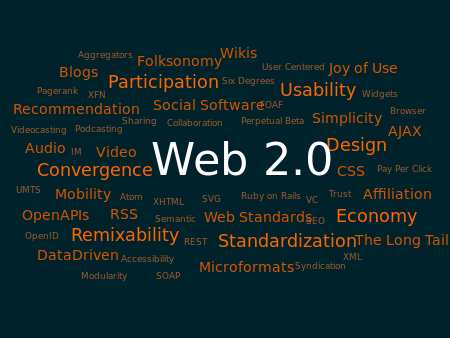
 A Web 2.0 site may allow users to interact and collaborate with each other in a social media dialogue as creators of user-generated content in a virtual community, in contrast to Web sites where people are limited to the passive viewing of content. Examples of Web 2.0 include social networking sites, blogs, wikis, folksonomies, video sharing sites, hosted services, Web applications, and mashups.
Web 2.0 sites allow users to do more than just retrieve information. Instead of merely 'reading', a user is invited to 'write' as well, or contribute to the content available to everyone in a user friendly way. They provide the user with more user-interface, software and storage facilities, all through their browser. Major features of Web 2.0 include social networking sites, user created Web sites, self-publishing platforms, tagging, and social bookmarking. Users can provide the data that is on a Web 2.0 site and exercise some control over that data.
Characteristics
Web 2.0 offers all users the same freedom to contribute. While this opens the possibility for serious debate and collaboration, it also increases the incidence of "spamming" and "trolling" by dishonest or distrustful users. The impossibility of excluding group members who don’t contribute to the provision of goods from sharing profits gives rise to the possibility that serious members will prefer to withhold their contribution of effort and free ride on the contribution of others. This requires what is sometimes called radical trust by the management of the Web site. The characteristics of Web 2.0 are: rich user experience, user participation, dynamic content, metadata, Web standards, and scalability. Further characteristics, such as openness, freedom and collective intelligence by way of user participation, can also be viewed as essential attributes of Web 2.0.
Technologies
The client-side (Web browser) technologies used in Web 2.0 development include Ajax and JavaScript frameworks such as YUI Library, Dojo Toolkit, MooTools, jQuery, Ext JS and Prototype JavaScript Framework. Ajax programming uses JavaScript to upload and download new data from the Web server without undergoing a full page reload.
To allow users to continue to interact with the page, communications such as data requests going to the server are separated from data coming back to the page (asynchronously). Otherwise, the user would have to routinely wait for the data to come back before they can do anything else on that page, just as a user has to wait for a page to complete the reload. This also increases overall performance of the site, as the sending of requests can complete quicker independent of blocking and queuing required to send data back to the client
.
Concepts
Web 2.0 draws together the capabilities of client- and server-side software, content syndication and the use of network protocols. Standards-oriented Web browsers may use plug-ins and software extensions to handle the content and the user interactions. Web 2.0 sites provide users with information storage, creation, and dissemination capabilities that were not possible in the environment now known as "Web 1.0".
Usage
A third important part of Web 2.0 is the Social web, which is a fundamental shift in the way people communicate. The social Web consists of a number of online tools and platforms where people share their perspectives, opinions, thoughts and experiences. Web 2.0 applications tend to interact much more with the end user. As such, the end user is not only a user of the application but also a participant by Podcasting, Blogging, Tagging, Curating with RSS, Social bookmarking, Social networking and Web content voting.